
Instructions & Help
This page provides a compact, but complete overview of all features you need to run tournaments with KLUE Badminton.
For short, action-oriented step lists per tournament type, use the quickstart page.
New: The one-page print workflow guide for tournament staff is available here: Print system quick guide.
New: Documentation now also covers the court system with automation (court status and automatic assignments) and the QR view for players and spectators (notice preview). See the print system quick guide for details.
Tenants (Clients)
The software is multi-tenant. This means multiple clubs can use the system in parallel without seeing each other's data. A tenant (sometimes called a client) is the isolated workspace where one club (or department) manages its tournaments.

Register a tenant
A tenant is created automatically when you register the first administrator account. Use the registration link on the start page and enter both the account details and the desired tenant name. As a tenant name, use your official club name (optionally with a department suffix). Both the tenant name and the initial account name must be unique across the service. The first account has full administrator permissions and can manage additional accounts. Optionally you can upload a club logo under "Settings".
Create tenant
Tenants cannot be created manually without going through the registration process.
Delete tenant
To delete a tenant, please use the contact form with the subject "Deletion of tenant [name]". For security reasons, the request must be sent from the email address of the tenant's primary administrator account.
Accounts
Accounts are user logins for people who access the system. They are not the same as players participating in tournaments. Accounts can either have write access (admin) or read-only access. Tournament organizers need write access; players should usually have read-only access. Players can also self-register for free (read-only by default).
Register an account
Using the registration link on the start page, users can create an account for an existing tenant (club) in order to view tournaments and results. Account names must be unique and belong to exactly one tenant. Club administrators can also create accounts and grant write permissions as needed.

Create accounts
In addition to self-registration, administrators can create accounts manually and assign read-only or write permissions.
Edit accounts
Accounts can be edited later. You can rename an account, update time zone or email address, and set a new password. Moving an account to a different tenant is not supported.
Delete accounts
If an account is no longer needed, you can delete it. Please do not delete the last account with write permissions. If this happens accidentally, please contact me via the contact form.
Lock accounts
If an account is only temporarily not needed, you can lock (and later unlock) it. Locked accounts cannot log in. Only administrators can unlock accounts.
Read-only users
Not every user needs write access. Club members who only want to follow the tournament progress can have a read-only account — this is the default after self-registration. With read-only access, users can:
- View all tournaments of the tenant.
- Follow schedules, results, and standings.
- Browse player and team lists.
- View KO brackets and Swiss standings.
- Access the courts view and notice preview.
The following requires write access (admin):
- Creating or editing tournaments, players, teams, or matches.
- Entering match results.
- Managing accounts or changing settings.
Login and navigation
Log in via the Login link on the start page. After logging in, the application is organized into the following main areas:
- Tournaments: overview and management of all tournaments for your tenant.
- Players: participant list, standings, and preset management per tournament.
- Teams: overview of fixed teams (for doubles or mixed tournaments).
- Matches: schedule, result entry, and round management.
- Courts: real-time court management and status (for hall operations).
Users with read-only access see the same structure, but all create, edit, and delete controls are hidden. The public notice preview (courts display, QR code) does not require a login at all — it is accessible via a signed link.
Tournaments
The system supports multiple tournament formats. For each tournament you can configure the points per set win, the number of sets required to win a match, the team size, and whether teams are fixed or generated dynamically.

Tournament modes
Below is an overview of the supported tournament systems.
Joke tournament
A joke tournament focuses on fun and variety. The system generates new teams each round and tries to maximize variation of partners and opponents while still keeping matches as fair and balanced as possible.
There are three additional sub-modes that influence how teams and matches are created:
- Equal team strength tries to form teams with similar total strength (based on presets and current performance). This can lead to matches where two strong teams play each other.
- Random team members prioritizes random mixing, while still aiming for balanced matches (often pairing a strong player with a weaker one).
- Switch after each round alternates between the two strategies above each round.
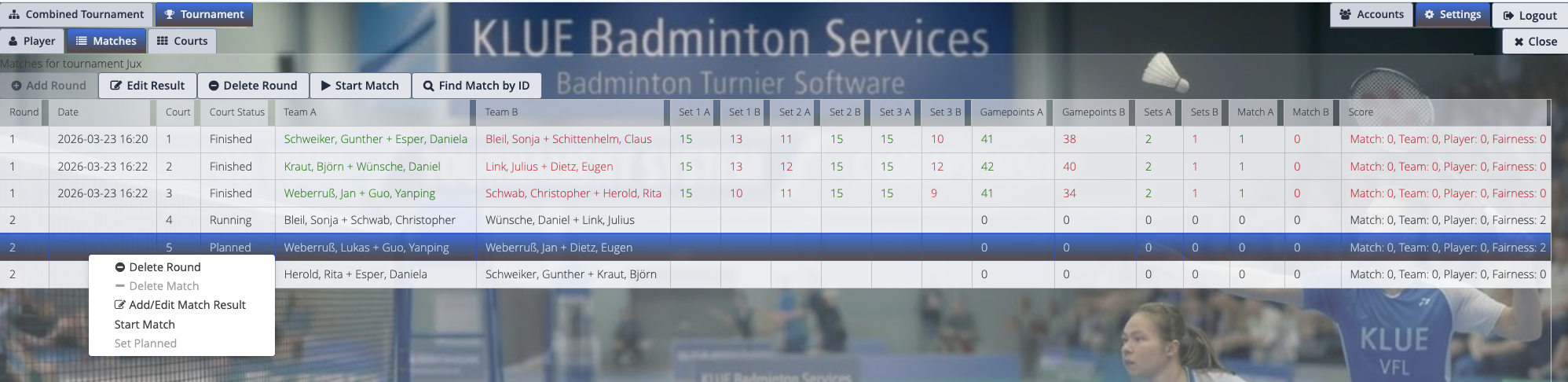
Fixed teams are not supported in joke tournaments. Typically you play doubles (teams of two), but single-player teams are also possible.
Rankings
Ranking tournaments are typically used to represent a club ranking list. You can run them yearly or continuously. Players (or coaches) are free to decide who plays against whom. The match date matters: older matches can be devalued automatically to keep the ranking list current and encourage regular play. Rankings are based on the ratio of wins to losses (not the absolute number of wins).

Ranking mode: current feature set
The ranking mode has been extended significantly and is now more transparent and configurable:
- Time-based decay: Optional per tournament (OFF, LINEAR_365D, HALF_LIFE_180D).
- Strength-based tie-breakers: Supports SOS_TIEBREAKER, UPSET_BONUS, and ELO_LITE.
- Head-to-head: Direct comparison for two-way ties and mini-table logic for multi-way ties.
- Configurable rule order: Ranking criteria order can be configured separately for players and teams.
- Duplicate match policy: Configurable as OFF, WARN, or BLOCK.
- Fairness warning: Detects and warns about large match-count imbalance.
- Table points: Optional point schemes (for example 3-1-0) via dedicated TABLE_POINTS rule.
- Print/export transparency: Active ranking rules are included in print and export outputs.
KO tournaments
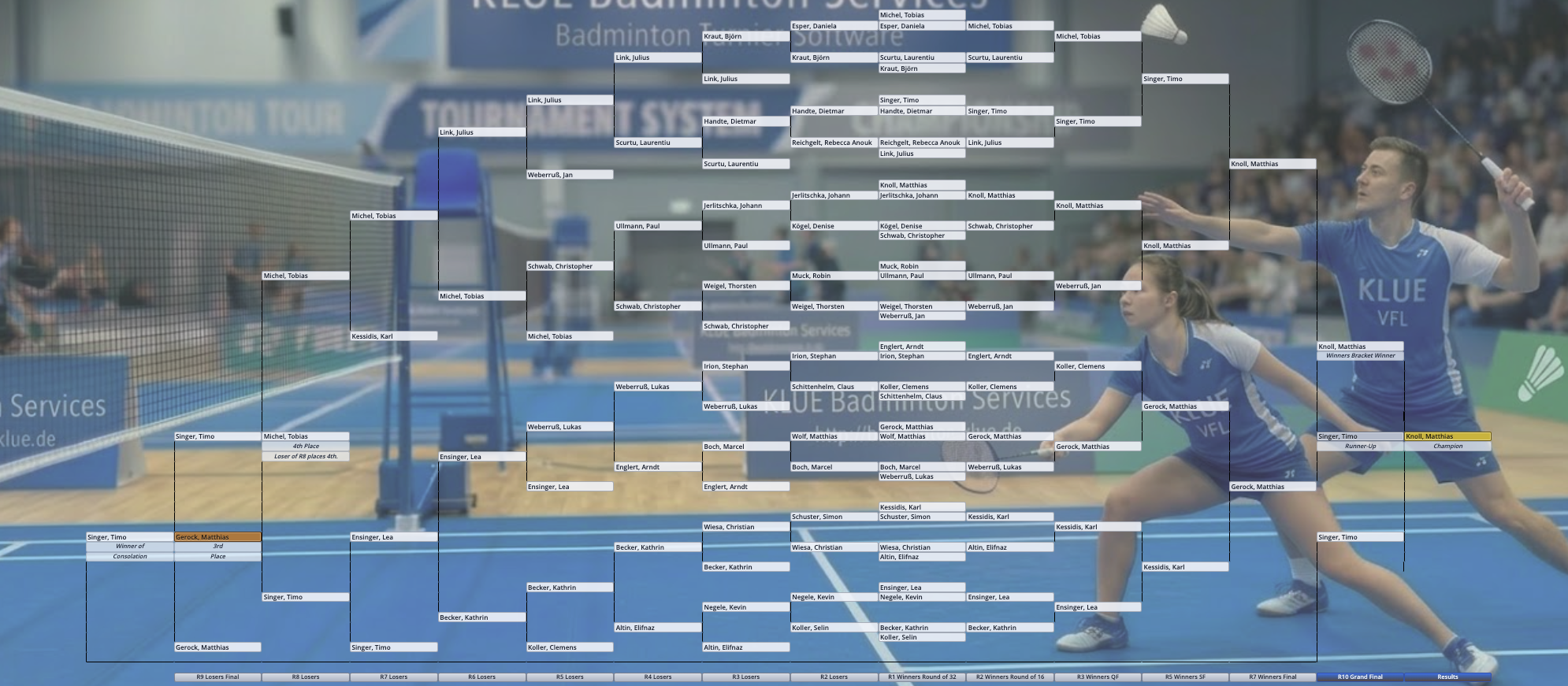
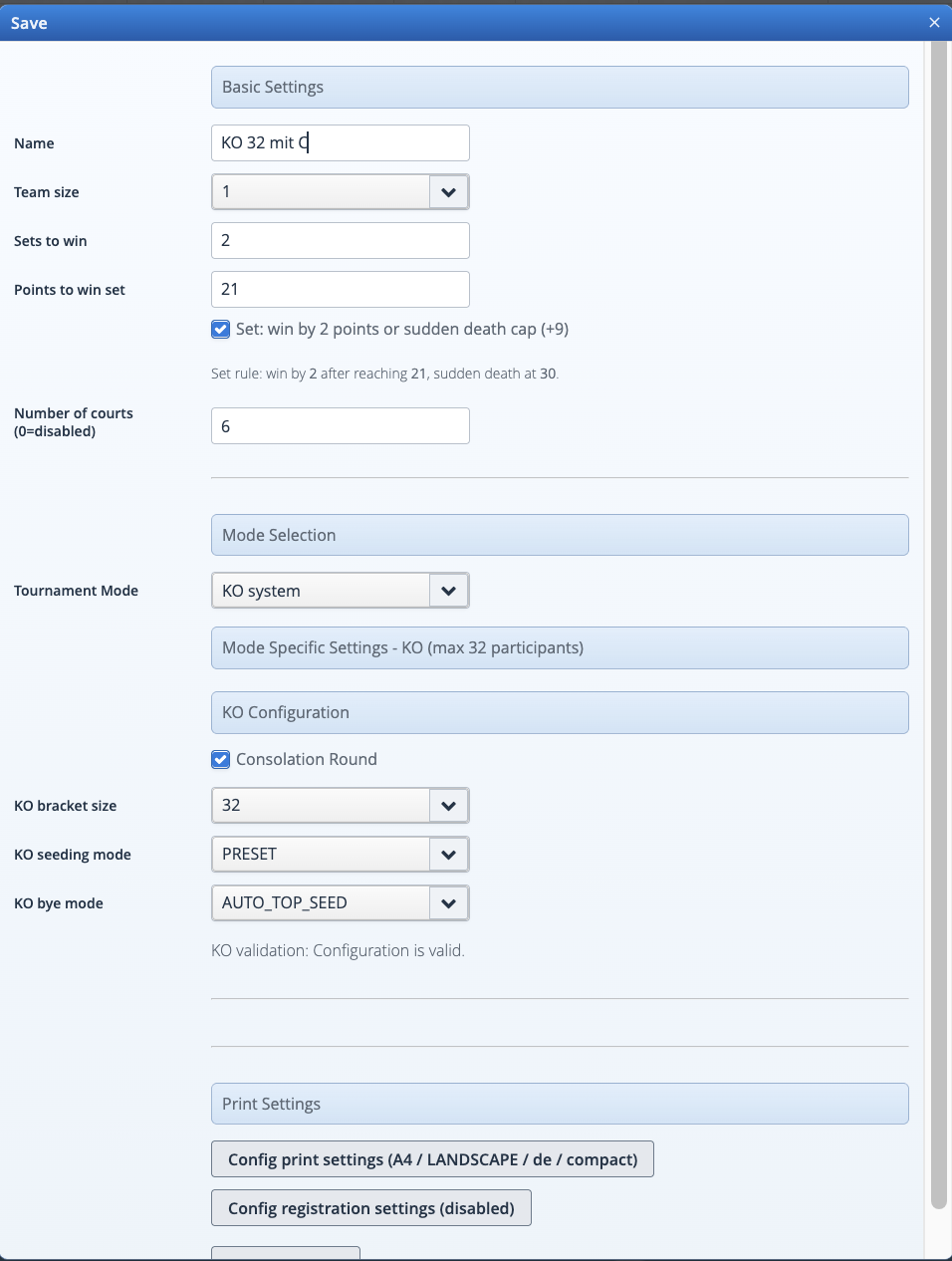
A KO tournament supports bracket sizes of 8, 16, or 32 teams. Teams may be single players, doubles, or mixed. If fewer teams are available, the remaining slots are filled with "dummy" entries (byes). You can play with or without a consolation bracket. With consolation, teams that lose in the main bracket get a second chance; without consolation, you play the classic stages (round of 16, quarter finals, semi finals, final). A dedicated bracket view helps visualize the current status at any point.
- 16-team KO with consolation: 8 rounds
- 16-team KO without consolation: 4 rounds
- 8-team KO with consolation: 6 rounds
- 8-team KO without consolation: 3 rounds
The bracket size (8 or 16) is currently determined automatically based on the number of selected teams.


Swiss system
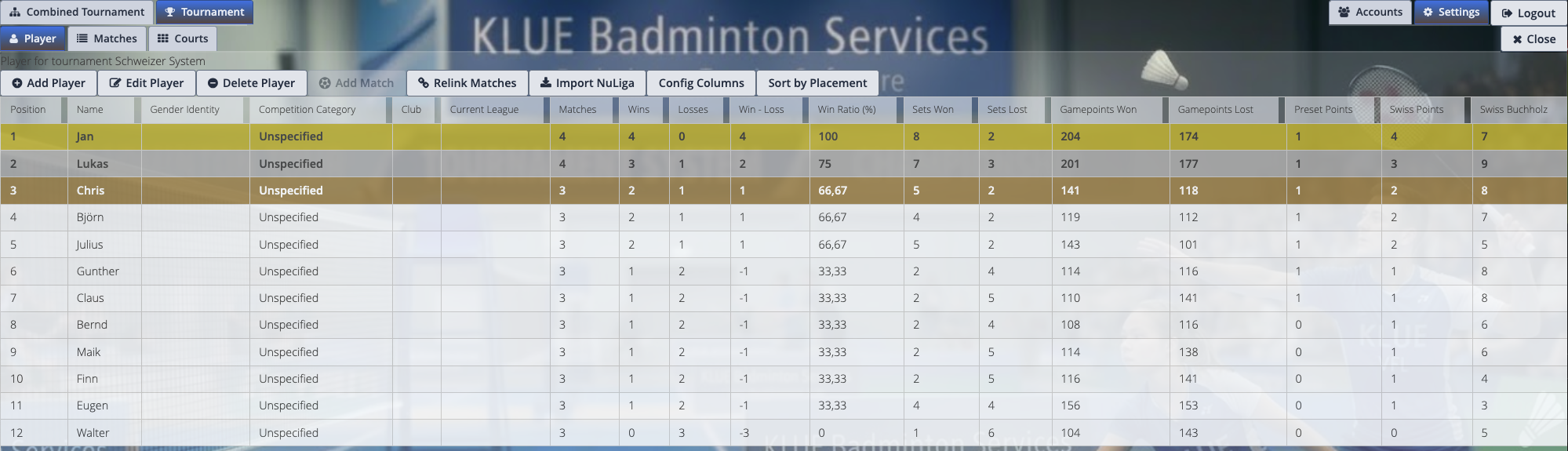
The Swiss system is a round-based format without immediate elimination. All participants keep playing over multiple rounds. After each round, pairings are recalculated so players/teams with similar current scores meet each other. This usually creates fair and competitive matches throughout the event.
Typical flow:
- Round 1: pairing by seeding (preset values).
- From round 2: pairing by Swiss points, avoiding rematches where possible.
- Odd number of participants: exactly one bye is assigned (with configurable bye points).
- Final standings: sorted by points and configurable tie-break order (for example Buchholz).
Recommended settings:
- Swiss rounds (0=auto): Use 0 for most club events. Set a fixed number only if your schedule is strict.
- Swiss: avoid rematches: Keep enabled in almost all cases.
- Swiss: allow byes: Keep enabled when odd participant counts are possible.
- Swiss: avoid duplicate byes: Keep enabled for fair bye distribution.
- Swiss bye points: 1 is a good default (bye is treated similar to a win).
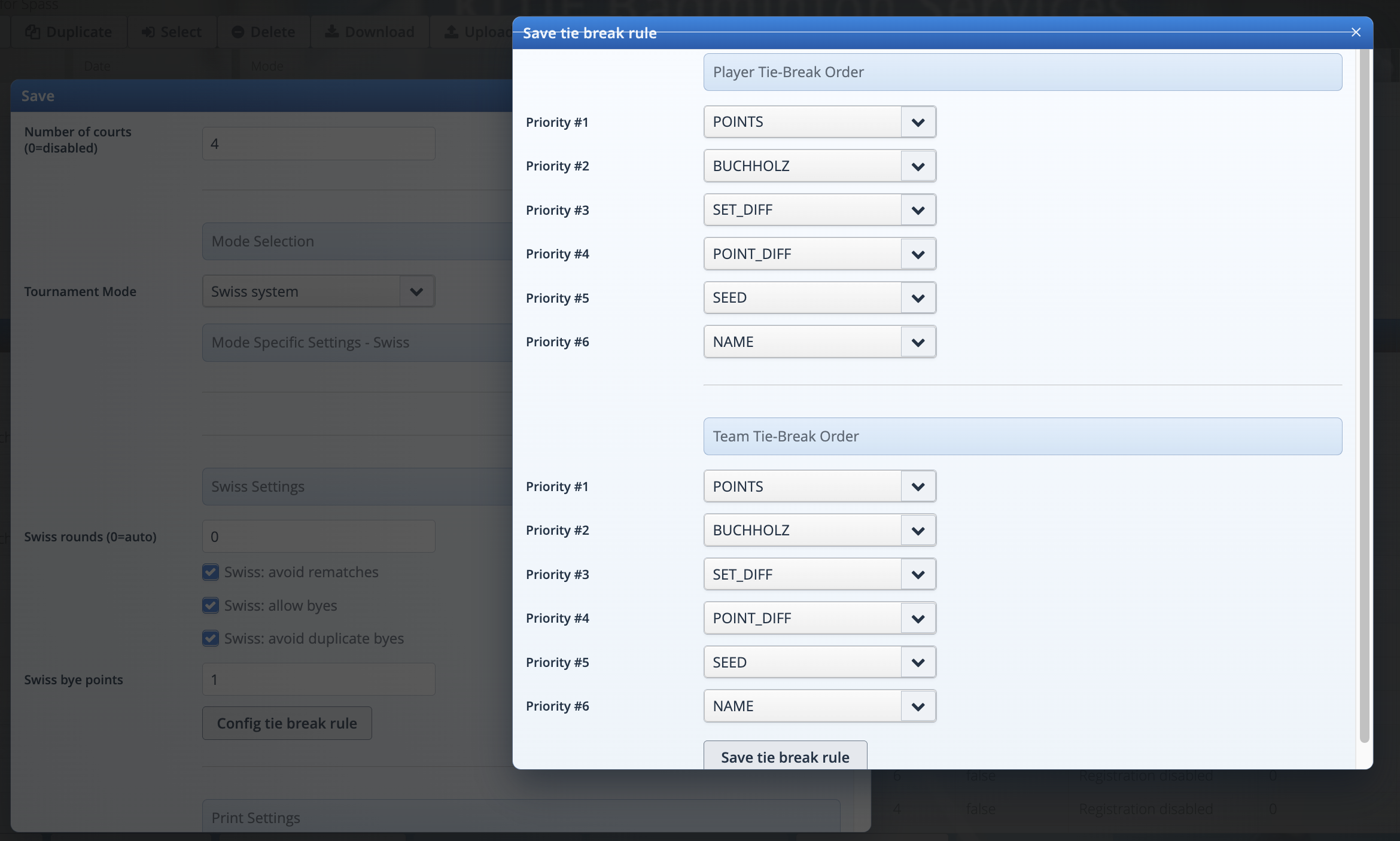
- Config tie break rule: Recommended default order is POINTS, BUCHHOLZ, SET_DIFF, POINT_DIFF, SEED, NAME.
When to use Swiss:
Use Swiss for medium and larger groups when everyone should play several rounds, but a full round-robin would be too long. Use KO for elimination drama, and round-robin when complete one-vs-one comparability is required.
Everybody against everybody
This mode is often used as a preliminary round before a KO phase. A group typically contains 3 or 4 players/teams; everyone plays against everyone. The system generates the required matches and rounds automatically.
- Number of matches: n * (n - 1) / 2
You can play either as teams or as single players.
Combined tournaments
Combined tournaments consist of multiple individual tournaments. A common setup is several preliminary groups followed by a final KO tournament to reduce the total number of matches. A combined tournament therefore has several "incoming" tournaments (usually of the same type) and one "outgoing" tournament of any type. You decide how many top teams advance into the final tournament. After the incoming tournaments are finished, teams are moved into the final tournament by clicking the combined tournament's "run" button.
Shared court pool across linked tournaments
Combined tournaments can use a shared court pool. In this mode, all linked tournaments use the same numbered courts and scheduling avoids double assignments across tournament borders.
- Configure shared courts in the combined tournament dialog.
- When shared courts are enabled, local court count fields in linked tournaments become read-only.
- The combined courts overview shows exactly one row per configured shared court.
- Use the combined Courts view to monitor and block/unblock shared courts globally.
Tournament Management
Create tournaments
In the tournaments tab you can create new tournaments. The overview lists tournaments by name, tournament type, team size and scoring settings (points per set, sets to win). You can also configure whether teams are fixed and additional expert settings for joke tournaments.
Edit tournaments
In general, you can change tournament parameters as long as the tournament has not been started yet. For example, changing the tournament mode or team size no longer makes sense once matches/results exist.
Delete tournaments
Usually you don't need to delete tournaments, but you can. Keep in mind that settings, players and match data are permanently removed (unless you exported the tournament first).
Copy tournaments
If you plan to run a similar tournament again, you can duplicate an existing one. Settings, teams and players are copied – match results are not.
Export tournaments
You can export tournaments and save them locally. This can be used as a backup and also for importing into the same or another tenant. The export contains all tournament data.
Import tournaments
With import you can restore a previously exported tournament. Importing into a different tenant is supported. Compared to duplication, import includes all data and dates (including matches). When importing into the same tenant, simply choose a new tournament name.
Detailed operations guide for tournament staff
This section describes an end-to-end operational flow for tournament staff, from preparation to wrap-up. The steps work for regular club nights as well as larger event days.
Preparation before event day
- Select the right mode (joke, KO, Swiss, round-robin, combined).
- Define scoring: points per set win, sets to win, and team size.
- For Swiss, keep recommended defaults (auto rounds, rematch avoidance on, bye rules on).
- When useful, duplicate a previous tournament and only adjust name/details.
Player setup and seeding quality
- Add players manually or reuse existing lists.
- Only maintain presets manually where verified league data is unavailable.
- Create fixed teams only for formats that require stable partners.
NuLiga import for real club workflows
The NuLiga import is optimized for recurring club imports, especially in larger clubs with multiple teams.
- Open the Start NuLiga Import dialog in the players area.
- Fill all required fields: Association, Season, Age Group, League, Division, and Round Type.
- The start button is enabled only when the selection is valid.
- For follow-up imports, the last valid selection is prefilled automatically.
- The player's current league from the player profile is the leading source for preset calculation, which is important for large clubs where listing pages may include mixed levels.
Running the tournament live
- Generate rounds/matches step by step and enter results continuously.
- Use the courts view to manage court status and next matches.
- Provide the QR-based notice preview for players and spectators.
Wrap-up and reuse
- Verify final standings and export results if needed.
- Duplicate the tournament as a template for the next event.
- Only clear NuLiga cache manually when external source data is inconsistent (Clear NuLiga Cache).
Typical issues and quick fixes
- Import does not start: Verify all required fields, including Round Type.
- Unexpected preset values: Check profile league data in NuLiga and run a follow-up import.
- Outdated external data: Clear cache and run import again.
Public Tournament Registration (Operator Runbook)
Public registration operations are managed centrally in Tournament Registrations. This section is an operations runbook for tournament staff, covering both standard flow and incident handling.
Roles and responsibilities
- Tournament Lead: final decisions in conflicts and all cases after tournament start.
- Registration Operator: queue processing, plausibility checks, documentation.
- Court/Schedule Operator: protects schedule integrity during manual interventions.
- Communication Operator (optional): informs affected players/teams about manual decisions.
Standard daily workflow
- Review queue: prioritize `SUBMITTED` and `NEEDS_REVIEW`.
- Inspect details: plausibility, reason, comment, review log.
- Decide: `Approve/Import`, `Reject`, or `Re-open`.
- Verify: player appears in target roster/combined input and logs are complete.
Combined rules before and after start
Before start
- Automatic reassignment is allowed.
- Commit Rebuild From Pool is allowed.
- Move Player Between Inputs is allowed.
After start
- No automatic reassignment in input tournaments.
- No automatic rebuild commit.
- No manual move between inputs.
- Manual lead decision only, with explicit documentation.
Runbooks for critical incidents
Self-cancel after start
- Check queue entry status `CANCELLED` and reason.
- Verify whether input/schedule has already started.
- Lead decision: `keep`, `replace`, or `walkover` (rule-compliant).
- Document time, owner, and rationale.
Rebuild blocked
- Use Preview Rebuild From Pool for transparency.
- Do not bypass the block technically.
- Take manual case-by-case decisions.
Event-day checklist
Pre-flight (before first match)
- Queue cleared or pending items explicitly prioritized.
- Combined pool state checked (active, assigned, unassigned).
- Roles assigned clearly (Lead, Registration, Court).
Live operations
- Review queue every 15 minutes.
- Assess new `CANCELLED` entries against start-state immediately.
- After start, avoid automatic rebuild/move actions.
Post-flight
- Close all open registration cases consistently.
- Review notable manual decisions briefly.
- Track improvements in TODO for next event.
Player management
Players are not accounts. A player represents a badminton participant inside a tournament.
Configurable columns in the player list
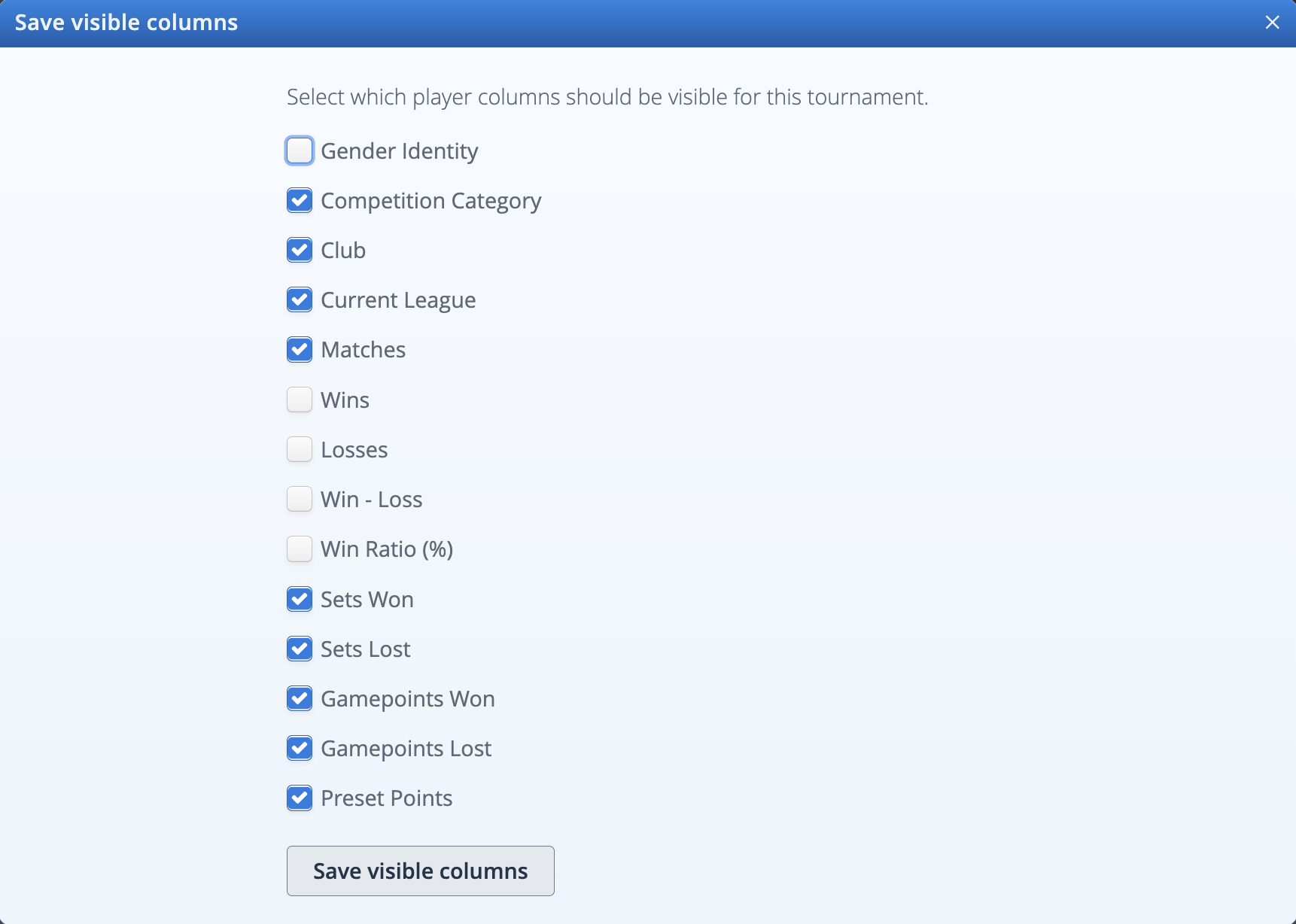
The player list adapts to the current tournament mode. Using the Configure columns button you can show or hide optional columns (for example Club, League, Sets, Game points, Swiss-specific columns). The selection only affects the current view and stays active until the page is reloaded.

Create players
Players are identified by their name (nicknames are fine). Player names must be unique within a tournament and are assigned to exactly one tournament (except in combined tournaments). Each player can have a "preset" value (typically 0–10). A preset greater than 0 indicates above-average strength and is used for seeding in KO tournaments and for balancing in joke tournaments. Negative values are reserved for dummy/byes and should not be used manually.
Preset logic in detail (including NuLiga import)
Preset handling is implemented to produce stable and explainable values in real club operations. Manual tournaments still support direct preset editing, while NuLiga imports apply the following rules:
- Leading source: The player's current league from the player profile is authoritative. Listing pages with mixed teams are no longer the primary source.
- Round context: Import selection respects the selected Round Type (first half / second half).
- Per-player evaluation: Presets are derived per player from individual league data, not from a single group-wide listing.
- Fallback behavior: If no reliable league can be extracted for a player, manual adjustment remains possible in the tournament.
- Import safety: Very long external text values are clamped before persistence to prevent database truncation errors.
Recommendation for tournament staff: After an initial import, run one follow-up import with the same selection (prefilled automatically) if values look suspicious, then adjust only exceptional players manually.
Edit player
You can rename players and adjust their preset value – even during an ongoing tournament.
Delete player
You can delete a player as long as they are not assigned to a match or have already played. Otherwise you must remove that player's matches first.
Teams
Players are grouped into teams. Teams can be dynamic (generated automatically each round) or fixed (stable partners across the tournament, e.g. doubles/mixed). Dynamic teams are usually not shown directly. Fixed teams can be used in most tournament modes – joke tournaments require dynamic teams by design.

Fixed teams
Fixed teams are common for doubles and mixed. Joke tournaments are the exception and cannot use fixed teams.
Create teams
Create teams in the teams tab by selecting players and grouping them together.
Delete teams
Teams can only be deleted if they are fixed and have not played any matches.
Rounds
Tournaments are typically organized in rounds. Depending on tournament type and number of teams/players, each round contains a certain number of matches.
Create rounds
Create a round in the "Matches" tab using the corresponding button. The system then generates the matches for that round. Rankings don't have explicit rounds – each match has its own round instead.
Delete rounds
Rounds can be deleted under certain conditions. In general, you can delete the most recent round. In KO tournaments, only the last round can be deleted.
If you delete rounds in the middle, round numbers will be re-ordered.
Matches
Matches are the individual games of a tournament and belong to a round. In some modes you cannot create matches freely: in KO tournaments matches depend on previous results; in joke tournaments they are generated randomly. In rankings there are no rounds, so you create matches directly.

Create match
Creating a match means selecting the competing teams. Teams can represent single players or fixed teams.
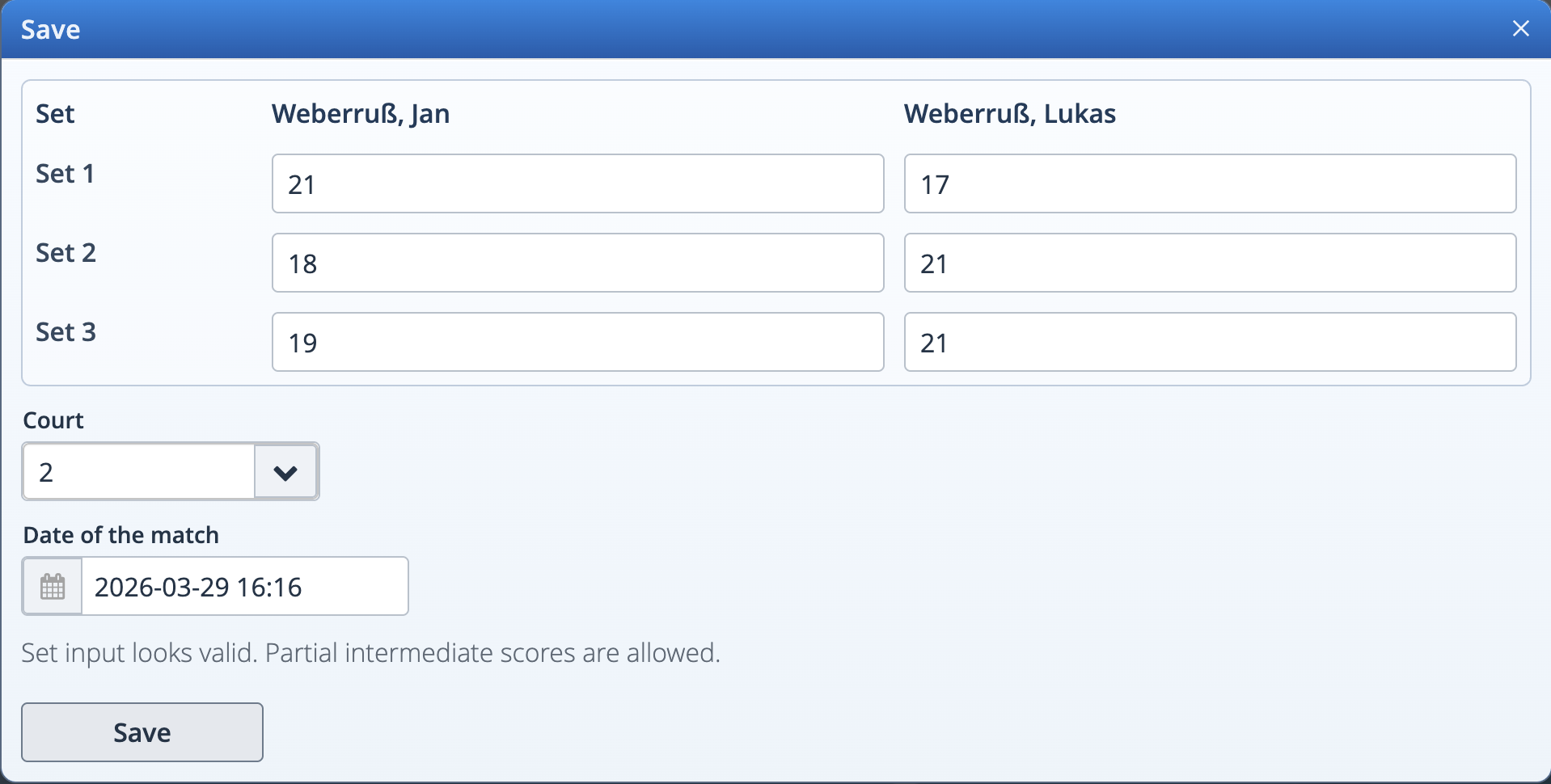
Enter match result
After a match, enter the result. Depending on the configured number of winning sets, you record the set scores accordingly. The system automatically determines winner and loser.
Delete match
Matches can be deleted in some situations (most commonly in rankings). Deleted data is permanently removed and cannot be restored.
Court System (Courts)
The court system provides a live per-court overview for tournament staff, players and spectators. It shows which match is running now and which one is up next.

Per-court status model
- Configured Status: manually controlled availability (for example maintenance or temporary block).
- Live Status: runtime status from tournament flow. In single tournaments: PLANNED, RUNNING, FREE. In linked shared-court setups: RUNNING_LOCAL, PLANNED_LOCAL, BUSY_EXTERNAL, PLANNED_EXTERNAL, FREE.
- Running Match / Planned Match: current and next match for each court.
- Owner: indicates whether usage belongs to this tournament or another linked tournament.
Manual control and automation
- Use Clear to mark a court as available.
- Use Block to exclude a court from assignment.
- Automatic assignment respects blocked courts and skips them for new matches.
- Refresh synchronizes the courts view with current match data immediately.
QR view for players and spectators (Notice Preview)
The notice preview is a public read-only display focused on court information. It is intended for hall displays, phones and spectators.
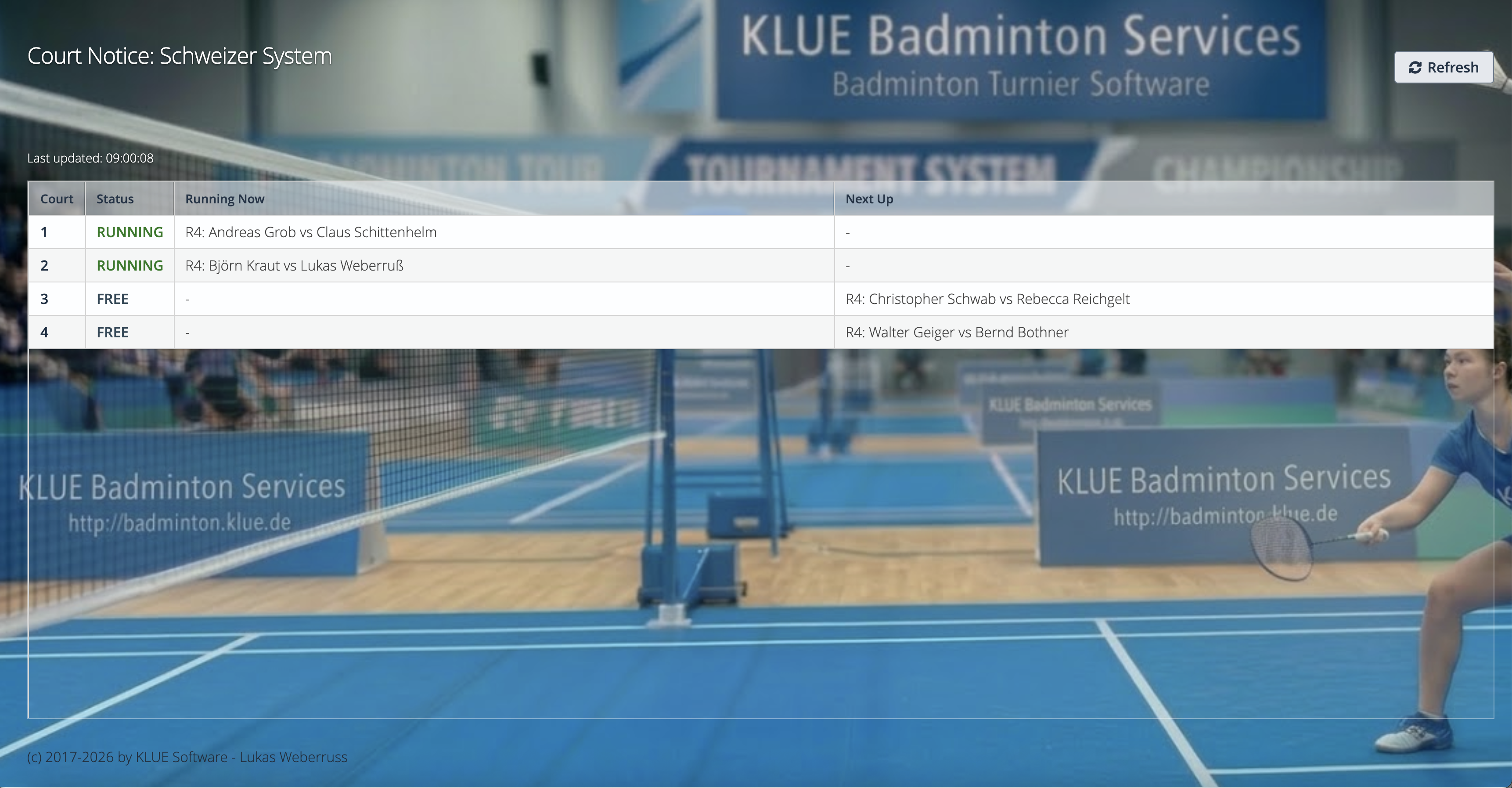
- Open it via Open Notice Preview in the tournament view.
- Access is secured by a signed URL with expiry time.
- In shared-court mode, notice resolves tournaments tenant-safe and shows effective courts from the shared pool.
- The notice view refreshes automatically every 60 seconds.
- This allows safe sharing without granting write access.
For a short on-site flow, see the print system quick guide.
Running a tournament (recommended workflow)
A typical tournament flow looks like this:
- Create the tournament with the desired parameters.
- Add players (players tab).
- Create rounds or matches (matches tab).
- Enter results (matches tab).
- Track the current standings in the players or teams tab.
Evaluate tournament
Current standings are available at any time via the players or teams tab. As soon as results exist, the system calculates placements and statistics automatically. In case of a tie, the configured tie-break rules are applied. The KO bracket view shows the current bracket state graphically.